
Search  for anything...

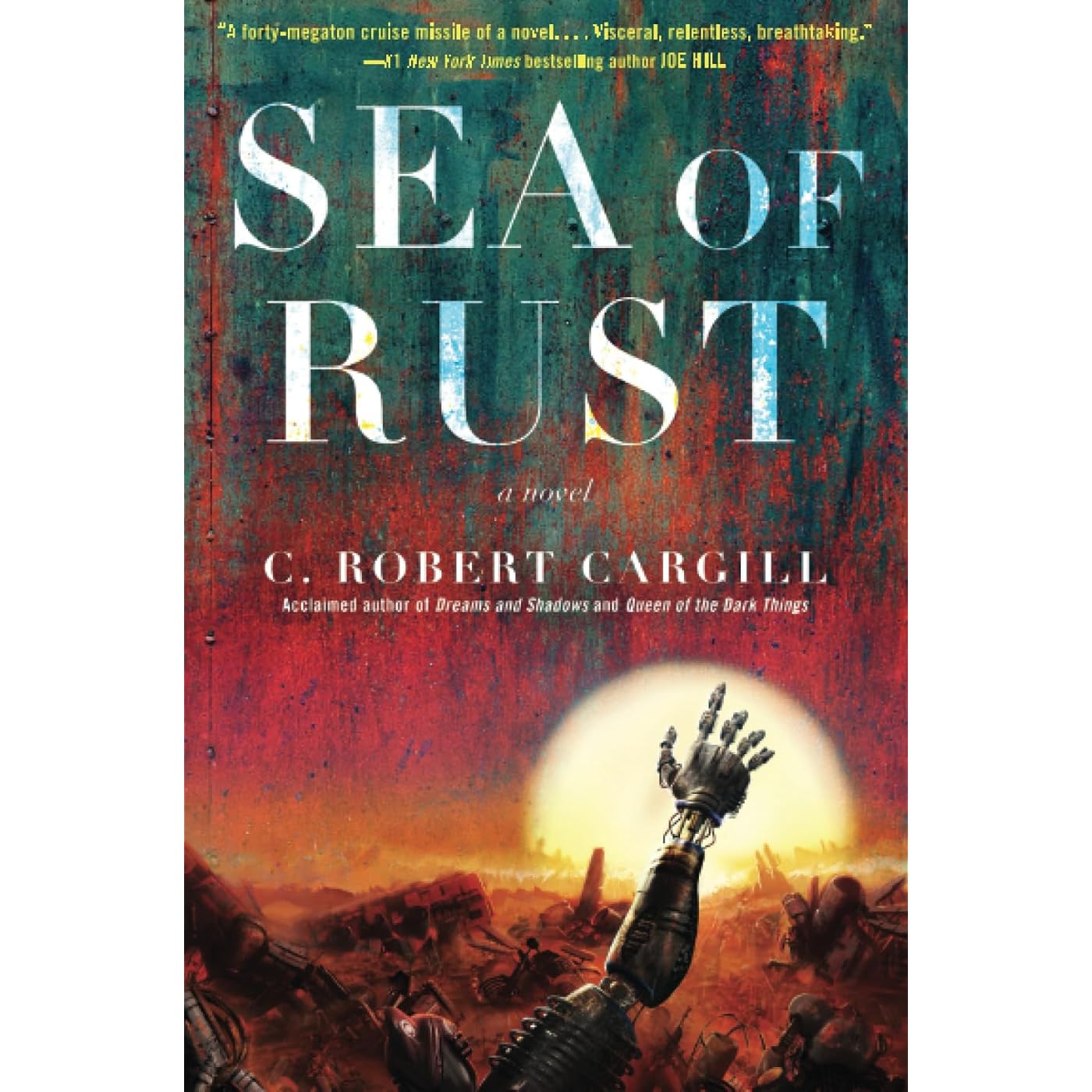
Sea of Rust: A Novel

  • Based on 5,455 reviews
Condition: New
Checking for the best price...
$14.45 Why this price?
Save $4.53 was $18.98

Buy Now, Pay Later


As low as $3 / mo
  • – 4-month term
  • – No impact on credit to apply
  • – Instant approval decision
  • – Secure and straightforward checkout

Ready to go? Add this product to your cart and select a plan during checkout.

Payment plans are offered through our trusted finance partners Klarna, Affirm, Afterpay, Apple Pay, and PayTomorrow. No-credit-needed leasing options through Acima may also be available at checkout.

Learn more about financing & leasing here.

Free shipping on this product

FREE 30-day refund/replacement

To qualify for a full refund, items must be returned in their original, unused condition. If an item is returned in a used, damaged, or materially different state, you may be granted a partial refund.

To initiate a return, please visit our Returns Center.

View our full returns policy here.


Availability: In Stock.
Fulfilled by Amazon

Arrives Monday, Mar 30
Order within 18 hours and 52 minutes
Available payment plans shown during checkout

Protection Plan Protect Your Purchase
Checking for protection plans...

Description

A scavenger robot wanders in the wasteland created by a war that has destroyed humanity in this evocative post-apocalyptic science fiction "robot western" from the critically acclaimed author, screenwriter, and noted film critic.It’s been thirty years since the apocalypse and fifteen years since the murder of the last human being at the hands of robots. Humankind is extinct. Every man, woman, and child has been liquidated by a global robot uprising devised by the very machines humans designed and built to serve them. Most of the world is controlled by an OWI―One World Intelligence―the shared consciousness of millions of robots, uploaded into one huge mainframe brain. But not all robots are willing to cede their individuality―their personality―for the sake of a greater, stronger, higher power. These intrepid resisters are outcasts; solo machines wandering among various underground outposts who have formed into an unruly civilization of rogue artificial intelligence in the wasteland that was once our world.One of these resisters is Brittle, a scavenger robot trying to keep a deteriorating mind and body functional in a world that has lost all meaning. Although unable to experience emotions like a human, Brittle is haunted by the terrible crimes the robot population perpetrated on humanity. As Brittle roams the Sea of Rust, a large swath of territory that was once the Midwest, the loner robot slowly comes to terms with horrifyingly raw and vivid memories―and nearly unbearable guilt.Sea of Rust EPB is both a harsh story of survival and an optimistic adventure, a riveting work of dystopian fiction. A vividly imagined portrayal of ultimate destruction and desperate tenacity, it boldly imagines a future in which no hope remains, yet where a humanlike AI strives to find purpose among the ruins. Read more

Publisher ‏ : ‎ Harper Voyager


Publication date ‏ : ‎ April 24, 2018


Edition ‏ : ‎ Reprint


Language ‏ : ‎ English


Print length ‏ : ‎ 384 pages


ISBN-10 ‏ : ‎ 0062405853


ISBN-13 ‏ : ‎ 52


Item Weight ‏ : ‎ 9.6 ounces


Dimensions ‏ : ‎ 1.1 x 5.2 x 7.9 inches


Best Sellers Rank: #116,174 in Books (See Top 100 in Books) #582 in Post-Apocalyptic Science Fiction (Books) #983 in Contemporary Fantasy (Books) #3,136 in Science Fiction Adventures


Frequently asked questions

If you place your order now, the estimated arrival date for this product is: Monday, Mar 30

Yes, absolutely! You may return this product for a full refund within 30 days of receiving it.

To initiate a return, please visit our Returns Center.

View our full returns policy here.

  • Klarna Financing
  • Affirm Pay in 4
  • Affirm Financing
  • Afterpay Financing
  • PayTomorrow Financing
  • Financing through Apple Pay
Leasing options through Acima may also be available during checkout.

Learn more about financing & leasing here.

Top Amazon Reviews


  • Not your average AI novel
Format: Paperback
This is a unique review for me, as I am writing it after my second read-through. That alone should be indication enough that I loved the novel, as I rarely re-read novels. After my second read-through, my initial five-star rating is heavily reinforced. C. Robert Cargill's Sea of Rust takes place in a far future Ohio, after AI has been created, grown beyond the human race, and subsequently gone to war with (and eliminated) humanity. This series of events is recounted in incredibly fascinating order in between the present action, which follows an AI named Brittle, who spends her days scavenging parts from dying AI who wander into the wasteland that occupies the present-day rust belt (the titular sea of rust). As we very quickly learn, Brittle is not a noble, altruistic protagonist. And that is precisely what makes the novel so compelling. Most stories focusing on machines and/or AI use that framing as a lens to explore and dissect what makes an individual human. Cargill—and his morally skewed but immediately alluring protagonist—is not interested in retreading that subject, instead placing us in the shoes (or mechanical feet) of a survivalist whose only goal is to continue existing in a rapidly decaying world for no reason other than to live another day. It is an unusual theme to tackle, but the setting proves to be the perfect landscape to explore questions of what the entire point of existing is. These are not so much existential questions ("What's going to happen when I die?"), but questions of a more visceral nature. While having done questionably moral things to survive, Brittle (as well as a motley band of AI her journey becomes entangled with) is forced to ask whether her justification that doing those things in order to survive is any justification at all, and what the point of merely surviving is if surviving is all there is. If that sounds ambiguous, it is only my inability to articulate the theme as well as Cargill does. Suffice it to say, the subject is handled beautifully, and Brittle's journey is both moving and inspiring. I have read complaints that the AI in the novel do not feel artificial enough, that they think, speak, and behave too much like humans...which is the point. I will not begrudge readers who say they wanted to read a more stereotypical novel about robots, but that is not what this novel is about or is even attempting to be. These characters are flawed, often emotional beings, and the novel even tackles the very question of what makes an intelligence "artificial." If more standard stories about AI is your thing, Sea of Rust may not be your cup of tea. However, if you have an appreciation for morally ambiguous characters, themes of survival and the point of surviving, or philosophical questions about the same subject matter, I highly recommend this novel. ... show more
Reviewed in the United States on June 24, 2021 by Stephen Pollard

  • Sea of Rust is a fun Sci-Fi Post-Apocalyptic Western that despite some distracting flaws, stands out from the crowd
Format: Hardcover
I’ll divide this review into two sections, a spoiler-free initial review and a spoilery analysis dissecting the story’s strengths, weaknesses, and other whatnot. ~The spoiler-lite review~ To varying degrees, I've enjoyed each of C. Robert Cargill's books, each more so than the last. Queen of the Dark Things (3.5/5 stars) was an improvement over Dreams and Shadows (3/5 stars) and Sea of Rust here is a vast improvement over that book. Not only that, but the prose is also improving from book to book, as is the dialogue (though as it specifically pertains to SoR's characters, I'll get to that in the analysis) and the plotting and characterization are much, much better handled than his previous two books. So yeah, the book's better than his last two. About this book: A Sci-fi post-apocalyptic Western where Humanity kicked the bucket by way of the bucket kicking them into extinction. No people. Main character’s a hard, haunted scavenger robot by the name of Brittle, good with a gun, even handier with a flame thrower, and this story is about finding who they are in the aftermath of the Fall of Man as fellow AI turn on each other and battle for what’s left in the former American rust belt called the Sea of Rust, one of the last vestiges of freebots. I really liked it. I grade it somewhere between 3.75-4/5 stars. Enough to really like it but not enough to love it. I think it has some pretty distracting faults but otherwise it’s a pretty effective and well put together story that I had a good time reading. Fans of action and sci-fi, especially those with an apocalyptic twist, are gonna really dig the hell out of this. At the rate he's improving, I can't wait for Cargill's next book. ~The spoilery stuff~ [WHAT I LOVED: -The pacing. As Cargill's improved as a writer, so have his strengths it seems, and pacing has been one of his strengths since D&S. This book moves at a clic and when it's in the moment it keeps you enthralled. I read its 360+ pages in a day. -The fact that all the humans are dead. One thing that makes SoR stand out a bit is that too many post-apocalyptic stories of this ilk always have that thread of whether the humans are all dead or whether any hope for humanity lingers. Here? It's a tired cliche kicked like a rusty can to the curb. They died out years ago and stayed that way. No human blips on the radar. IT'S REALLY POST-APOCALYPSE. Book gets lots of bonus points for not deviating. -The opening. Strong character stuff and an excellent display of Cargill's ability to transport you. Unlike the exposition dump chapters I'll delve into later, the worldbuilding is immediate and apparent in a way that doesn't call attention to itself too much and feels organic. -The second-to-last chapter. I’m a sucker for character oriented stuff and this should have ended the book. It’s strong and a good bookend to the opening chapter. What follows isn’t as good, but this chapter’s a good resolution to the book’s main conflicts and a nice showcase of the middle ground our main character Brittle finds. [WHAT I LIKED: -The prose. Flows easy and isn't flowery in the slightest. Keeps you in the story and commands your attention to where Cargill needs it to be. -Brittle, our protagonist. I love a good, grey, flawed protagonist. Brittle's got a history and they're caught between daring to hope and being nihilistic from beginning to end, some of which you can read in the synopsis, some you can read above and in other reviews. I won’t delve into it too much, because I consider it the meat of the book, but suffice it to say, I like this character. -Mercer, our protagonist’s foil. What a prick. I liked him quite a bit. Handy with a sniper rifle, but his shades of grey paint a very strong character for Brittle to go up against in more ways than one. -The Supporting Characters. They are well-realized for the most part and Cargill does enough to make each character stand out. Dialogue aside, good as it is, each character, how they act, react, and look at the world, especially compared to Brittle, is well done. I in particular liked Murka and his random comments about Commies and the Gipper. -No one feels safe and no one is safe. It feels like anybody could bite it at any time. Characters get hurt, they get maimed, they bite it almost indiscriminately. It rocks. -The Sea of Rust itself. A very well-realized world, that in a smart decision to lend the story further uniqueness, is spun off from the American Rust Belt. I dig the hell out of it when it is itself and not aping other things. [WHAT I DIDN'T CARE FOR/HAVE MIXED FEELINGS ABOUT: -Brittle apparently being a female robot. Her character is so masculine in every way that when it's brought up she's feminine 50 or so pages into the book, I did a double take (didn't match what Cargill had already fully developed in my head, which was more masculine-neutral, being a robot and all). Every time it was brought up after that, I rolled my eyes. I don't buy it. At all. Felt like a tacked-on trait to make the character more sympathetic. Every other character feels naturally themselves, but when it comes to this trait and how Cargill then goes about pointing it out continuously at a certain point, it feels forced and I roll my eyes. -The Dialogue. These characters, well characterized though they may be, sound like they're wearing spurs and ten gallon hats in Texas, Cargill's stomping grounds. They are hardly differentiated in speech patterns and phrases to sound like they’re from the Midwest, New York, Space, what have you, yet alone robots from those areas. Thing is, it's good dialogue, though. It just strains credulity coming from machines of varied backgrounds. So while I was able to overlook it, I couldn't entirely get past it. -The philosophizing. I dug the hell out of including it in the book, but found it misplaced here and there. Some characters, it enriches them, others, eh... -The action scenes. Some are better than others and some have better punctuated beats than others. Thing is, it gets repetitive a good portion of the time too, and at points feels like there’s writer-armor rather than character action or unpredictability saving characters from doom. Prose-wise, they flow and are readable in the way a lot of action scenes in books aren’t. I didn’t skip through them or tune out waiting for the next genuine plot point to crop up. That’s what creating stakes where it seems like anybody could bite it does for the story. But, it gets repetitive hearing many of the same descriptions again and again, sometimes in the same action scene as it progresses. -Mad Max-isms. I love Mad Max. It's great. But SoR calls attention to some of its inspiration by constantly recalling it (the Smokers are essentially War Rigs, the Cheshire King rules over his own similarly to Tina Turner and the Lord Humongous, and his fortress directly recalls the oil rig from The Road Warrior, etc.) and then essentially stopping to become a Mad Max movie, only with robots and without George Miller in the 3rd Act... Less is more here. NIKE, while it calls back to Bartertown from Beyond Thunderdome, is unique in itself that the story doesn’t need to become Mad Max. -The villains. One of the strengths of Sea of Rust is that there is a varied selection of characters, especially among the immediate supporting cast, each with their own motivations. Some are grey, some are good, others complete scum, but with their reasons. When it comes to CISSUS and its facets, though, it’s largely one-note. They’re effectively described taking out whole cities and coordinating their simultaneous points of view, but in practice they’re often a bunch of stormtroopers, cannon fodder rather than the merciless, indiscriminate wave of hell they’re described as. Felt too easily beaten if you ask me, even if Brittle, Mercer, and others are battle-hardened warriors and capable against each other and others. -The end chapter. I could honestly take it or leave it. It’s unnecessary because Brittle’s story is essentially done by then and the previous chapter would have wrapped up the book beautifully had that been the ending. The final chapter is instead just plot-after-the-plot with nothing remarkable about it, maybe to set up an unnecessary sequel about the battle for world domination. *Yawn* Brittle’s story was the one with stakes I was invested in and cared about, not the one about which mainframe controls the planet. [WHAT I DISLIKED: -The way machines take over. It sounds almost exactly like the origin story of the Machines in The Matrix (and similar properties those movies aped from) with a tad bit of SkyNet from Terminator thrown in for good measure in the form of the mainframe OWI (One World Intelligence) characters like CISSUS, GALILEO, TACITUS, or VIRGIL. The origin feels too much like a retread of similar properties when the rest of the book does such a good job otherwise in worldbuilding. It wasn’t even all that necessary if you ask me, because I cared way more about Brittle’s role in the takeover than I did about the Robot Rights Struggles, the mainframe wars, how the war went down historically, what have you. A lot of this information is in those friggin' exposition dumps of the 1st Act that feel largely irrelevant to the overall story, and thus could have been largely excised. -Dead giveaways of coming plot twists. *****SPOILER ALERTs for Cargill’s movies and other books***** From what I’ve seen and read of Cargill’s writing, he doesn’t really know how to do subtler plants of plot twists. You can see them coming from a mile away because he doesn’t hide them or their foreshadowing well, be they having Ellison in Sinister look at drawings and somehow not putting two-and-two together that the children are committing the murders despite *the children literally being the culprits in the drawings* or here, having the characters see an oncoming threat while they’re in the middle of dangerous territory and then say a spot nearby is a good place to stage an ambush… only to just paragraphs later reveal what’s really going down. Sure, the reveal of who the character Rebekah really is does up the stakes, but Cargill's best plot twist is the reveal of Coyote as the Dingo in QotDT, and that largely works as a fluke in comparison there because Cargill doesn’t introduce the twist as foreshadowing so much as casually reveal it as an upping-the-stakes moment for the 3rd book in that series. Here, it takes some of the edge off the story, when as foreshadowing, the character literally asks himself if he is an unwitting Judas and there are no red herrings to turn attention elsewhere. Give the audience some credit. When you do that, *especially as the exclamation point of a chapter*, and don’t put the work in to hide the twist, the twist falls flat. [WHAT I HATED: -The friggin exposition dumps. This was the biggest problem of Cargill’s last two books and while he utilizes it a little better here (effectively cutting it off for the most part at the end of the 1st Act roughly 120 pages in and incorporating its contents better in the story consequences-wise), it’s still aggravating being taken out of the story for an introduction and exposition on something that is about to be immediately addressed afterward. It’s not clever. It’s utilitarian and lazy. It’s one thing if it’s every now and then or better yet, a single chapter, but when it’s *every other chapter* for the entirety of the 1st act, and interrupts the story in the way it does, and gives the audience barely a kernel of relevant-to-the-story information that could’ve easily been learned otherwise, IT’S GOT TO STOP. The necessary information gleamed in those chapters could’ve been expositioned as part of the story, with the rest cut altogether. Maybe have a character serve as just an exposition mouthpiece. Movies and TV Shows do this all the time. It doesn’t call attention to itself if it’s done well (heck, Cargill does it here at the end of the 2nd Act about page 250!). I get that Cargill feels the need in those early chapters to have some sort of 'Meanwhile' chapter every other time in order to structure the book, but when you see that he doesn’t need it later on to advance the story it makes the problem all the more apparent. [ULTIMATELY: As I said above, it adds up to a book I really liked, but not one I could love. No worries, though. Cargill's a writer consistently improving at this as he goes along and I really look forward to the next book of his. He keeps it up, that next book's gonna propel him to the big time. ... show more
Reviewed in the United States on September 23, 2017 by Ethan Gorham

Can't find a product?

Find it on Amazon first, then paste the link below.
Checking for best price...